Dog & Cat Dental Care in Williamsburg
Your pet's mouth affects their whole-body health, and dental disease is easy to miss. At our Williamsburg hospital, we handle everything from routine cleanings to advanced problems — so small issues never become painful ones.
Your pet's mouth is a window into whole-body health.
By age three, most dogs and cats already show signs of dental disease — and because pets are so good at hiding oral pain, it often goes unnoticed until it's advanced. Caught early, most problems never become painful.
- Chronic bad breathOften the very first clue something needs attention.
- Drooling or bleedingAt the mouth, or a yellow-brown crust along the gumline.
- Dropping food, or appetite changesOr shying away when you touch the mouth.
- Loose, broken, or missing teethWorth acting on early — pets hide oral pain well.

Anesthesia, monitored every minute.
Before any dental procedure, we run a full physical exam and bloodwork to confirm your pet is a good candidate for anesthesia.
Throughout the cleaning, we track oxygen, carbon dioxide, ECG, blood pressure, heart rate, and temperature — and use local anesthetic to keep your pet comfortable if an extraction is needed.
What happens during a dental cleaning?
Because pets won't hold still for a thorough cleaning, dental procedures are done under anesthesia. We use ultrasonic power scalers and hand instruments to remove tartar from the teeth, both above and below the gum line, where disease often hides.
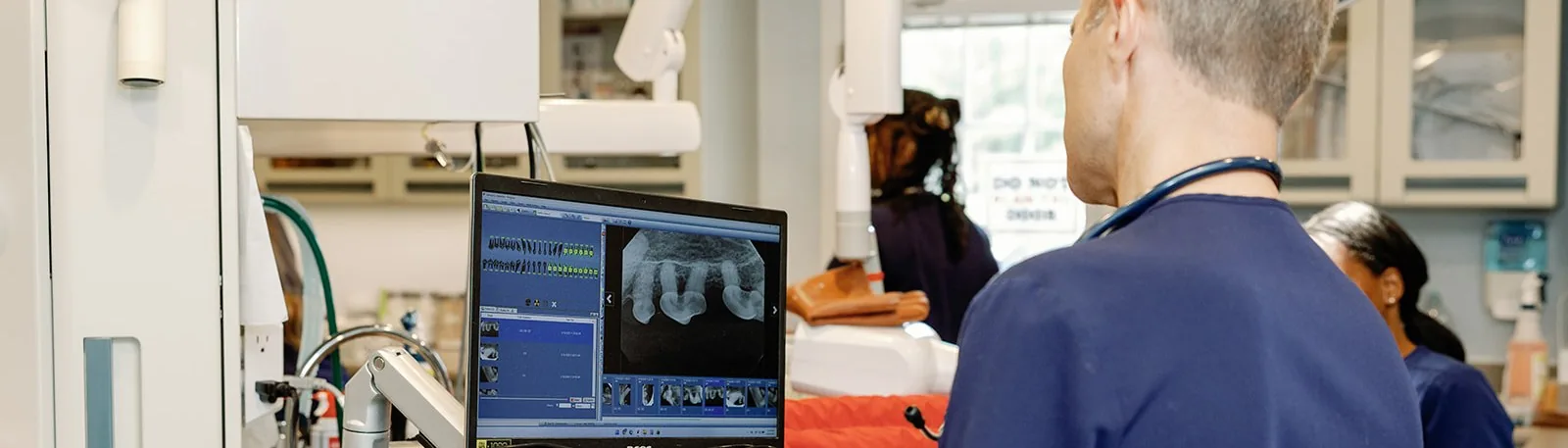
We take dental radiographs at every cleaning, because much of what matters sits beneath the gumline where the eye can't reach. X-rays show us abscesses, fractured roots, and the resorptive lesions that are common in cats — problems a visual exam alone would miss.
Catching problems early gives us more treatment options, which is why we recommend a dental check-up once a year.
Is anesthesia safe for my pet's dental work?
Yes, and we take careful steps to keep it that way. Before any dental procedure, we perform a full physical exam and run bloodwork to make sure your pet is a good candidate for anesthesia.
During the procedure we monitor oxygen levels, carbon dioxide, ECG, blood pressure, heart rate, and temperature the entire time, and we use local anesthetic injections to reduce pain if an extraction is needed.
Will my pet need a tooth extraction?
Sometimes, but our goal is always for your pet to keep as many teeth as possible. When a tooth is too diseased to save, an extraction relieves pain and stops periodontal disease from spreading to nearby teeth and tissue.
Caught early, many dental problems can be treated without extraction, which is one more reason routine dental check-ups matter.
Healthy teeth make for a happier pet.
Call us or request a dental appointment online, and we'll take a careful look.